Save Crown Hill Cemetery!
Join us in protecting Crown Hill Cemetery as a place of rest, remembrance, and community heritage.As a reminder: Many of you have already signed this petition (advocating for the City to conduct a formal SEPA (State Environmental Policy Act) Review to ensure this sacred land isn't damaged by rushed construction), but if you haven't, please do so and forward it broadly and widely to all your networks! We'd like to get up to 500 signatures, so then we can send it to city leadership and local media.
Thank you!! Link: https://www.change.org/p/request-a-sepa-review-to-protect-crown-hill-cemeteryNext Meeting: Join us next Thursday on January 29th at the Greenwood Library to discuss the next phase of our strategy to help defend Crown Hill Cemetery. We'll discuss what the city's halt means for us, as well as our plan to protect the trees & cultural site.Meeting Details:
Date: January 29, 2026 (next Thursday)
Time: 6:30 PM – 7:30 PM
Location: Greenwood Public Library (8016 Greenwood Ave N)Digital: Available via Zoom
How to Join: If you cannot attend in person, please email [email protected] to receive the Zoom link.Jan 14, 2026 Update: Thanks to your incredible support, we submitted over 330 public comments—shattering our goal! Because of our collective efforts, the City has officially flagged the developer’s plans, effectively stalling the project.This delay means the development must now face stricter regulations. We will provide any updates.Also, scroll all the way down to find out how you can help and get involved, as well as read a history of Crown Hill Cemetery and learn more about our neighbors buried there.
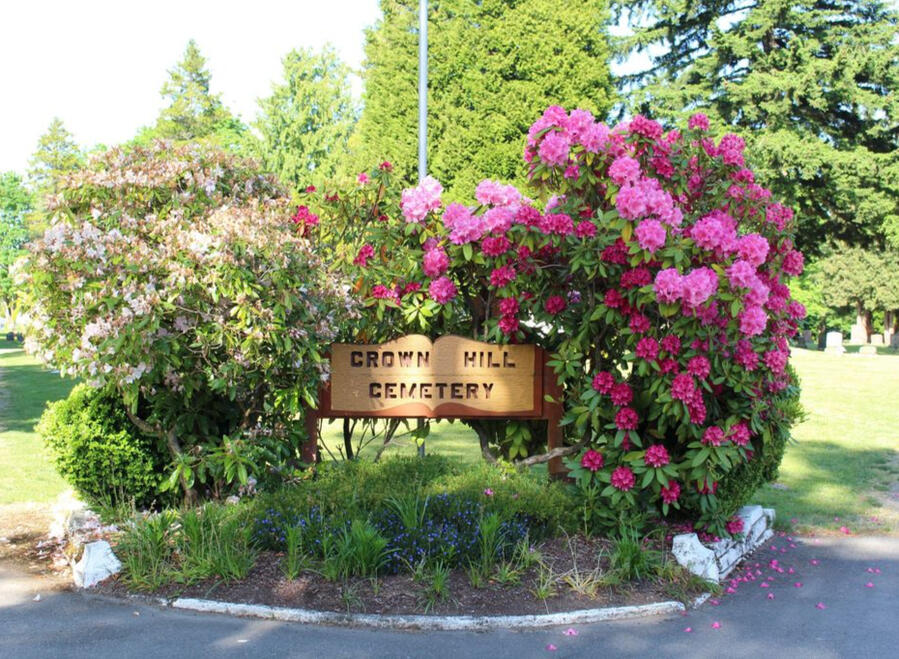
What's Happening?
Project Update: We’ve Stalled the Development
Hello Community! We wanted to wait until we had all the facts before sharing this major update. Our collective strategy is working, and we have some incredible news to share.1. We Smashed Our Goal!
A massive THANK YOU to everyone who spoke up. Our goal was 50 comments—we ended up with 337 comments filed by the deadline. This is a massive showing for a project of this size and potentially a city record!2. Current Status: "Needs Corrections"
Thanks to the tireless work of our volunteers—we successfully challenged the developer's legal right to access the site through the cemetery. On January 5th, the City conducted an inspection and agreed: the applicant has not demonstrated legal access.The project is now on hold. To move forward, the developer must:Provide a recorded access easement.Obtain a separate SDOT Street Use Permit for a new driveway.Meet strict safety and fire-access standards on their own property.3. Why This Delay is Good
By catching these legal flaws, we have successfully run out the clock. The developer tried to rush this through in December to avoid Seattle's new 2026 tree protection rules. Because the project is now stalled, any re-application may have to follow these much stricter environmental laws(although not guaranteed), which better protect our heritage trees and could force a total redesign.4. What’s Next: The SEPA Appeal
While we’ve won this round, the fight isn't over. We are moving into the SEPA Appeal phase to force the City to address cultural resources, hydrology, and cemetery adjacency.Political Outreach: We are now in Council District 5. Please contact Councilmember Debora Juarez and Mayor Katie Wilson to let them know you oppose this project.Join Our Strategy Meeting
When: January 29, 2026 | 6:30 – 7:30 PMWhere: Greenwood Public Library (or via Zoom). Please contact us if you want the zoom linkStay tuned, and thank you for helping us protect Crown Hill Cemetery!To Get Involved:Volunteer Signup: https://forms.gle/c6nJrHchQaoE8Csa7Change Petition: https://c.org/nv5rqKPnSHDiscord (Community Server): https://discord.gg/ADAqfkhkFacebook Page: https://www.facebook.com/profile.php?id=61585444495150Instagram Page: https://instagram.com/savecrownhillEmail Contact: [email protected]Website: https://savecrownhill.carrd.co/For More Media Sources/Coverage:Cascade of History Interview with "Save Crown Hill Cemetery" Coalition Leader: https://open.spotify.com/episode/0sFtO3dHBEuTmGvSkb0Oh2KOMO News. (2025, December 24). Neighbors rally to prevent home builds near Crown Hill Cemetery. KOMONews.com.
https://komonews.com/news/local/crown-hill-cemetry-seattle-neighborhood-dr-burrows-development-projects-122-year-old-95-acres-applicant-parcel-pacific-crest-mayor-elect-katie-wilsonKOMO News. (2025, December 18). Neighbors push back on Crown Hill Cemetery redevelopment plan. KOMONews.com. https://www.komonews.com/news/local/crown-hill-cemetery-redevelopmentSeattle Medium. (2024, February 12). Owners forced to sell Crown Hill Cemetery after loan default. SeattleMedium.com. https://www.seattlemedium.com/owners-forced-to-sell-crown-hill-cemeteryInvestigateWest. (2025, September 10). Developers accelerate tree removal ahead of new Seattle ordinance. InvestigateWest.org. https://www.investigatewest.org/2025/09/10/developers-accelerate-tree-removal-seattleKING 5 News. (2025, February 17). Crown Hill Cemetery housing plan stirs concern [Video]. YouTube. https://www.youtube.com/watch?v=qOXGirZAESMKING 5 News. (2025, February 17). Crown Hill Cemetery housing plan stirs concern. King5.com. https://www.king5.com/article/news/local/seattle/crown-hill-cemetery-developments/281-1485017f-591b-4263-a76c-ca42198e6c48
A History of Crown Hill Cemetery


Crown Hill Cemetery, founded in 1903, stands as one of Seattle’s oldest community burial grounds and the earliest landmark of what is now the Crown Hill neighborhood. Long before houses, paved streets, or commercial development appeared, the cemetery occupied nearly ten acres of heavily forested land north of Ballard. Its presence predates most surrounding homes and even the neighborhood’s name, which was derived directly from the cemetery itself—underscoring its foundational role in the area’s history.At the turn of the twentieth century, Ballard was a booming industrial town known as the “Shingle Capital of the World,” with a population of more than 10,000 residents by 1900 and dozens of mills operating along the waterfront. As Ballard expanded rapidly, the need for additional burial space became urgent. In September 1902, a cemetery association was formed, land was purchased, and clearing began. A road was extended north from Ballard to serve the new burial ground. By 1903, half of the land had been cleared, and the first interments took place, marking the official founding of Crown Hill Cemetery.Crown Hill’s early years coincided with significant changes in Seattle’s burial landscape. In 1907, approximately two dozen bodies were moved to Crown Hill from the nearby Greenwood Cemetery (formerly Woodland Cemetery), which had been established in 1891 by pioneer David T. Denny and later sold for residential development. This transfer reinforced Crown Hill’s role as Ballard’s primary community cemetery. From the beginning, it served residents of modest means as well as prominent local figures, reflecting the social fabric of a working waterfront town.The cemetery bears witness to major historic events. Victims of the 1918 Spanish influenza pandemic, including many infants and children, are buried there, a poignant reminder of early twentieth-century public health crises. In 1919, a fire destroyed a building and many cemetery records, leaving lasting gaps in documentation. Despite these losses, Crown Hill continued to evolve. In 1923, the cemetery was sold to Arthur and Louanna Marshall, who were also involved with Evergreen Washelli. Under their ownership, beautification efforts expanded, plantings were added, and a perpetual care section was established. In 1924, the grounds were replatted, removing some original roads and simplifying the layout to provide more burial space and a less formal, parish-style character that remains today.Crown Hill Cemetery is notable for its diversity and inclusivity. It is non-denominational and has always been open to people of all faiths or none. Although Ballard was predominantly Scandinavian, especially Norwegian, the cemetery reflects Seattle’s broader immigrant history. As one moves away from the oldest Scandinavian sections, markers representing Russian, Japanese, Chinese, Eastern European, and other communities appear, often clustered together. These graves, many modest and unadorned, reflect immigrant laborers, boarding-house residents, and families who contributed to Seattle’s growth but were often marginalized in life.The cemetery also serves as an important veterans’ memorial landscape. It contains the graves of at least 25 Civil War veterans—Union and Confederate—including soldiers, sailors, and even a Union Army nurse. Later generations of veterans from the Spanish-American War, World Wars I and II, Korea, and Vietnam are also interred there. Memorials within the grounds include a 1909 monument honoring the Grand Army of the Republic and other commemorations marking maritime tragedies and family legacies.
Despite its age and significance, Crown Hill Cemetery has remained a relatively small, community-focused burial ground, with fewer than 9,000 interments. Gates disappeared in the 1940s, reinforcing its open, neighborhood character.Today, Crown Hill Cemetery endures as one of the largest remaining green spaces in the neighborhood and a deeply personal repository of Ballard’s history. More than a burial ground, it is a living record of the workers, immigrants, children, veterans, and families who shaped Seattle — quietly anchoring a modern neighborhood to its past.
Who Lies Beneath Crown Hill: A History of Our Neighbors


Who Is Buried in Crown Hill Cemetery?Crown Hill Cemetery is less a roll call of famous names than a quiet record of the people who built, worked in, and lived ordinary lives in Ballard and north Seattle. Walking through its grounds is like moving through layers of the city’s social history, where immigrant laborers, children lost too young, civic leaders, veterans, and enigmatic figures rest side by side. Together, they form a deeply human portrait of Seattle’s past.Diverse and inclusiveIf you were a Mason, you were buried at Lakeview Cemetery on Capitol Hill. If you were Catholic, you spent your eternal rest at Calvary Cemetery in Ravenna.
But all were welcome at the Crown Hill Cemetery, especially if you were not one of the dominant religions and ethnic groups. The oldest sections reveal the city’s early diversity and the workers who came here for opportunity in the fisheries, mills, and railroads.Headstones and markers reflect a mix of ethnic communities, including Scandinavian immigrants alongside Russian, Japanese, and Chinese burials. These graves suggest Asian heritage interments dating to the early twentieth century, a period when Asian workers were present in Seattle’s mills, fisheries, railroad work, and service industries but often lived on the margins due to discrimination and segregation. Their presence at Crown Hill underscores the cemetery’s non-denominational and inclusive nature, welcoming people of many backgrounds at a time when other cemeteries were more restrictive.Record of community historyOne of the most affecting areas of the cemetery is the infant and children’s section. Rows of small markers testify to the high rate of infant and childhood mortality in the early 1900s, when disease, poor sanitation, and limited medical care claimed many young lives. Nearby are graves of victims of the 1918 Spanish influenza pandemic, which swept through Seattle with devastating speed. These burials mark a moment of collective trauma, when entire families and neighborhoods were altered by loss.Crown Hill also contains the graves of individuals with notable (and ordinary) roles in local and regional history:Emma J. Ray (1859–1930) is remembered for her involvement in the suffragist movement and civic life in Washington State.Minnehaha “Minnie” Webster Youngblood (1870–1944) was a wife and mother whose grave represents the many women whose lives shaped their communities in quieter but enduring ways.Jacob J. Bleitz (1867–1939), a long-serving funeral director, is buried among those he once helped lay to rest, a poignant reminder of the continuity of care in this community.Robert Arnold Ashmore (1925–1945), who died young during World War II, represents a later generation whose lives were cut short by global conflict.Paul M. Boe, born Paul Nikolai Andreassen in Norway, came to Ballard in 1903 and worked as a tailor. His life ended tragically in 1942 as he crossed 15th Avenue Northwest and was the victim of a hit and run driver, leaving behind a wife and seven children — an ordinary life marked by hard work and a quest for opportunity. His daughter Mary carried on his legacy to be voted “the most beautiful girl in Ballard High School” in 1913 and become a milliner at Frederick and Nelson.Cass Turnbull (1951–2017) was a Seattle-based gardener, writer, and activist best known as the founder of Plant Amnesty, a nonprofit created in 1987 to combat improper pruning practices and promote healthy, sustainable plant care. A largely self-taught horticulturist, Turnbull became a powerful public voice against tree topping and other damaging landscape habits, combining solid plant science with humor and plainspoken education. She reached a wide audience through Plant Amnesty’s grassroots programs, public demonstrations, and advice line, as well as through her long-running gardening column in The Seattle Times and her book Pruning: What, When, and How. Turnbull helped change urban forestry standards and public attitudes toward trees. Her legacy lives on through Plant Amnesty and the enduring impact of her advocacy for informed, respectful care of plants in urban environments. She is buried in the urn garden, fittingly under one of the tallest trees in the area.Local legends lie hereSome burials carry stories that border on legend.
The Sharpnack Mausoleum is one of the cemetery’s most distinctive structures, built by Henry Sharpnack over three years to resemble a small stone house. After his death by suicide in 1916, Sharpnack was buried inside, seated in his rocking chair. An inscription speaks of rest after sorrow, while local lore tells of visitors hearing the creak of the chair at night — an enduring ghost story woven into neighborhood memory.Other lives are remembered for their mystery rather than their monument. Mary Anderson, known as “the Cipher in Room 214,” died by suicide in 1996 at a downtown Seattle hotel. Her identity was unknown for years, and she was buried in an unmarked shared grave at Crown Hill. Her story, later uncovered and widely reported, reflects how even in death some lives can remain hidden, their recognition delayed but not erased.Crown Hill is also the resting place of prominent Ballard figures. Captain William Williams, known as “Captain Billy,” emigrated from Norway and became one of Ballard’s most famous citizens, operating a boathouse for 17 years and embodying the maritime culture that defined the community.Taken together, those buried at Crown Hill Cemetery represent far more than individual stories. They reflect hard work and a new start, loss and resilience, civic engagement and anonymity. The cemetery stands as a shared resting place for people of many faiths, cultures, and social standing, offering a rare, tangible link to the lived experiences that shaped Ballard and Seattle itself.